GEO Guide
How to Get Cited by AI Search Engines
Ask ChatGPT what to buy and it won't hand you ten links. It names three or four brands and moves on. To be one of them, make sure AI crawlers can read your site, publish pages that answer the exact questions buyers ask, and get your brand named on the reviews, roundups and threads the engines already trust. Then check the real answers, engine by engine, to see what's working. Here's how to do each part in ChatGPT, Perplexity, Gemini, Claude, Grok and Google's AI Overviews, whether you sell shoes, legal advice or software.
- AI engines mostly cite pages they find by searching the web at the moment someone asks. If their crawlers can't reach you, or you aren't in Google's and Bing's index, you're out before you start.
- The quickest wins are on other people's pages: the reviews, roundups and threads the engine already reads for your question. Find those first.
- On your own site, answer the question in the first two sentences, say plainly who you're for, and give specific facts a model can repeat.
- Check the real answers, engine by engine, every week or two. They change, and an average hides where you're losing.
What getting cited by AI actually means
Two different things get called "being cited", and it's worth pulling them apart before doing anything else.
- A mention is your brand named in the answer itself: "If you've got wide feet, try X or Y." This is the one that sells, because the buyer reads it as a recommendation.
- A citation is a link to a page the engine used as a source, usually a small numbered link or a card under the answer. It might be your site. It might just as easily be a review that talks about you.
You want both, and they're earned a little differently. Mentions follow from what the web as a whole says about you. Citations go to the specific page that answered the question best. The steps below cover both, and where the advice differs, it says so.
How AI search engines decide what to cite
Most of the AI answers your buyers read are put together in roughly the same way:
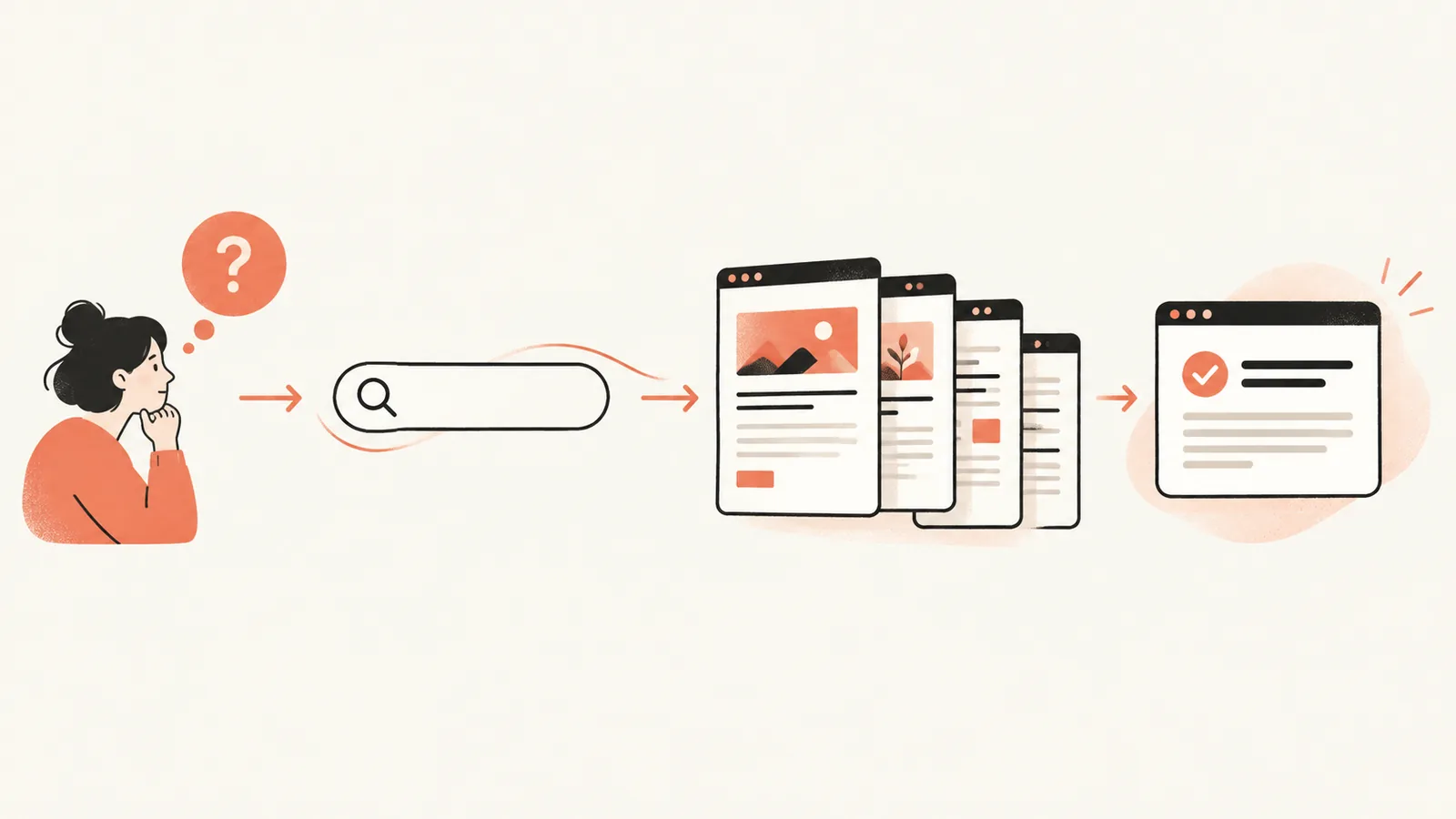
Two things follow from that. First, the engine can only recommend you if it found you during that search, so ordinary search visibility still matters a great deal. Second, it leans on agreement. If five pages it reads all name the same three brands, those three go in the answer. Being on one page isn't enough. You want to be part of the consensus.
There's also the model's own memory, the things it picked up in training. That's why ChatGPT can recommend a well-known brand with web search switched off. You can't edit training data, and it only changes when a new model comes out. But the things that get you into search results today (being written about widely and consistently) are the same things that end up in the next model's training data. So you're working on both at once.
Google says it plainly: there are no special requirements for showing up in AI Overviews or AI Mode. A page has to be indexed and eligible to appear with a snippet in normal search. If Google can't show you in search, its AI won't either. (Google Search Central: AI features and your website)
First, check what AI says about you today
Before you change anything, find out what the engines say right now. It takes about twenty minutes, and what you find decides what to work on first.
Start by writing down 5 to 10 questions a real buyer would type: whole questions, not keywords. Mix the kinds. The broad "best X" questions are the hardest to win, and the narrower ones are usually where your first wins come from.
| Kind of question | Examples |
|---|---|
| The shortlist | "Best running shoes for flat feet?" "Who's the best wedding photographer in Bristol?" |
| A specific need | "Best accountant for a freelance photographer?" "Which CRM suits a five-person sales team?" |
| Comparison | "[Brand A] or [Brand B]?" "Is there a cheaper alternative to [the brand everyone knows]?" |
| Problem first | "How do I stop my dog pulling on the lead?" "How long does a contested divorce take?" |
| Your own name | "Is [your brand] any good?" "[Your brand] reviews." This is what AI tells people who already know your name. |
Then go and ask them:
- Ask each one in ChatGPT, Perplexity, Gemini and Google (look at the AI Overview at the top). Use a private window so your own history doesn't bend the answer.
- For each answer, write down three things: were you named, who was named instead, and which pages were linked as sources.
That last column is the most useful thing you'll collect. The pages an engine cites for your question are the pages it trusts on your topic. They become your to-do list in step 7.
Doing this by hand once is well worth it. Doing it every week, across several engines and a dozen questions, gets old fast, and AI answers aren't fixed: the same question can get a different answer from one week to the next. That's the part CitedOrNot automates (more on that below).
12 steps to get your brand cited by AI
These are roughly in order. The first two are plumbing: if they're broken, nothing else counts. Steps 3 to 6 are about your own pages, 7 to 9 about what the rest of the web says about you, and 10 to 12 keep it all working.
1. Let AI crawlers into your site
It's the boring one, and it's easy to get wrong without noticing. Check your robots.txt, then check your CDN, firewall or security plugin too. Some of them now block AI bots by default, and often nobody on the team chose that.
Each AI company runs more than one crawler, and they do different jobs. The ones that fetch pages to answer a live question are the ones that decide whether you can be cited:
| Company | Reads pages to answer questions | Collects training data |
|---|---|---|
| OpenAI (ChatGPT) | OAI-SearchBot, ChatGPT-User | GPTBot |
| Perplexity | PerplexityBot, Perplexity-User | None listed separately |
| Anthropic (Claude) | Claude-SearchBot, Claude-User | ClaudeBot |
| Google (Gemini, AI Overviews, AI Mode) | Googlebot, the normal search crawler | Google-Extended (a robots.txt setting, not a separate bot) |
Blocking the training crawlers is a fair business decision, and plenty of publishers make it. Blocking the answer crawlers is something else: you're opting out of being cited. One quirk worth knowing is that Google-Extended has no effect on AI Overviews or AI Mode. Those run on Googlebot, the same as normal search.
If your robots.txt already allows everything, leave it alone. If it blocks bots broadly, you can make an exception for the answer crawlers like this:
# Let AI search and answer bots read the site
User-agent: OAI-SearchBot
User-agent: ChatGPT-User
User-agent: PerplexityBot
User-agent: Perplexity-User
User-agent: Claude-SearchBot
User-agent: Claude-User
Allow: /
2. Make sure Google and Bing have indexed you
Because AI answers start with a search, being in the index is the price of entry. Set up Google Search Console and Bing Webmaster Tools, submit your sitemap to both, and look at which of your important pages are actually indexed. Not just published. Indexed.
Bing is easy to forget, and that's a mistake. Microsoft Copilot runs on it, and ChatGPT's search draws on third-party search indexes that are widely understood to include Bing's. If your platform supports IndexNow, switch it on so Bing hears about new pages the day you publish them.
3. Put the answer in the first two sentences
When an engine reads your page, it's looking for a passage it can lift into its answer. A page that makes it dig through three paragraphs of brand story gives it less to work with than one that simply answers.
So write the way you'd answer a friend who asked. If the page is about whether your boots are waterproof, the first line says yes or no, and how you know. Then the detail. Use headings that match how people actually ask ("How long does a contested divorce take?"), and make each section make sense on its own, because the engine might quote one section and ignore the rest of the page.
4. Say exactly who you're for
Most buyers don't ask for "the best accountant". They ask for the best accountant for a freelance photographer, or for a restaurant with twelve staff. AI engines are good at matching those details, and they favour pages that state them outright.
A line like "independent restaurants and cafés in Bristol, usually 5 to 40 staff" gives the engine something to match. "Helping businesses grow" gives it nothing. If you serve three distinct groups, give each its own page, with proof that's specific to that group: their kind of customer, their kind of problem, their price range.
5. Publish honest comparison and "alternatives" pages
"X vs Y" and "alternatives to X" are some of the most common ways people ask AI for advice, and engines like pages that set a comparison out cleanly. If buyers weigh you up against a bigger name, write that page yourself, and be fair about it. Say where the other option is the better choice.
A comparison that reads like an ad gets discounted by readers and, more and more, by models. One that admits trade-offs gets quoted. A short table (price, who it suits, the main difference) and a plain "pick them if…, pick us if…" section do most of the work.
6. Give the engine facts it can repeat
Vague copy is hard to cite. Specific copy is easy. Prices, sizes, materials, opening hours, turnaround times, warranty length, where you deliver, how long you've been doing it: whatever is true and relevant in your category. Put it in plain text on the page, not only inside an image or a PDF.
There's research behind this. The 2023 paper that coined the term "generative engine optimization", by researchers at Princeton and IIT Delhi, found that adding statistics, quotations and cited sources to a page raised its visibility in AI-generated answers by up to 40% in their tests, while old-school keyword stuffing did little to help. (Aggarwal et al., "GEO: Generative Engine Optimization", KDD 2024)
If you have original data, publish it: a survey of your customers, your own test results, prices you track over time. It's the one thing competitors can't copy, and engines tend to cite whoever a number came from.
7. Get onto the pages AI already cites
This is the step that moves things fastest, and the one most brands skip. Go back to the sources you wrote down when you checked the answers. For a question like "best running shoes for flat feet", they're typically a few review sites, a couple of "best of" roundups, a Reddit thread or two and maybe a YouTube video. Those pages are what the engine believes.
Not every source deserves the same response. Sort them into three piles:
- Pages that recommend several options (roundups, directories, review sites, forum threads). These are your outreach list. Many roundups get updated regularly and their writers do take suggestions. Directories let you claim and fill in a listing. Threads let you join the conversation honestly.
- A competitor's own page. You won't get onto it, but you can publish a better answer to the same question on your own site: more specific, more current, more honest about trade-offs.
- Big platforms' own pages, like a marketplace or a chain retailer describing itself. There's usually no realistic way in. Note them and move on.
The reason this matters so much follows from how answers are built: the engine repeats what its sources agree on. If those sources don't mention you, a new page on your own site is one voice against several.
Keep it honest. Paying for a placement that isn't labelled as sponsored, or posting "been using these for years!" comments from fake accounts, gets threads removed and brands called out. Models read the call-outs too.
8. Earn reviews and real conversation
Engines read reviews and they read forums. For a local business, that means your Google Business Profile and whichever directories matter in your trade. For physical products, it's retailer reviews, specialist review sites and communities like Reddit. For software, sites like G2 and Capterra. Grok reads X heavily, and Perplexity often pulls Reddit threads straight into its sources.
You can't fake this one, and you shouldn't try. Ask happy customers for a review at the moment they're happiest, not in a mass email six months later. Answer questions in communities where you genuinely know something, under your own name, and say who you work for.
9. Describe yourself the same way everywhere
An AI engine builds its picture of your brand from many sources. If your site says you're a "sustainable footwear company", your Instagram bio says "minimalist sneakers" and a directory files you under "shoe repair", the model gets a blurry picture. Blurry brands get skipped.
Write one clear sentence about what you are and who you're for, and use it on your homepage, About page, social profiles, directory listings and press boilerplate. If you're a local business, keep your name, address and phone number identical everywhere. Add Organization or LocalBusiness structured data with sameAs links to your official profiles so the connections are spelled out rather than guessed.
10. Make your pages easy for a machine to read, and use structured data properly
Many AI crawlers fetch the raw HTML and don't run JavaScript. If your prices, product details or FAQs only appear after a script loads, there's a real chance the crawler never sees them. Open "view source" (not the inspector, which shows the page after scripts run) and check that the important text is actually in there.
Beyond that, the basics carry over from SEO: a clear title, one H1, sensible headings, a canonical tag and a sitemap.
Then add structured data (schema markup). It won't get a weak page cited, but it tells engines in plain terms what the page is, who it's from and what you sell, which removes guesswork, especially for the Google-based engines. Which types to start with depends on what you are:
| If you're… | Start with |
|---|---|
| A local business | LocalBusiness, or a more specific type such as Dentist or Bakery, with your address, opening hours and sameAs links |
| Selling products | Product with an Offer (price, availability), plus ratings only for reviews actually shown on the page |
| A software or service company | Organization, plus SoftwareApplication or Service |
| A person (consultant, author, creator) | Person with sameAs links to your official profiles |
| Any page with real questions and answers | FAQPage, matching the questions visible on the page |
One rule matters more than which types you pick: the markup has to describe what's visible on the page. A price in the schema that differs from the price on the page, or reviews you don't show, breaks Google's guidelines and hands engines a contradiction. An llms.txt file is cheap to add too, though so far there's little public evidence that the big engines rely on it.
11. Keep it current, and fix what AI gets wrong
For anything that changes (prices, "best of" lists, opening hours, product ranges), engines lean towards recent pages. Show a real "last updated" date and mean it: update the content, not just the date.
Read what the AI says about you, too, not only whether it names you. An answer can recommend a brand and still get its price, range or location wrong, often because an old page or a stale third-party listing still says so. Track down where the wrong fact comes from, fix it at the source, and make the correct fact easy to find on your own site.
12. Measure, change one thing, measure again
AI answers aren't fixed. The same question can get a different answer next week, and different engines often disagree with each other. So treat this as a loop: track the same questions on a schedule, ship one change, then check whether the answers moved for those questions on those engines.
Give it a few weeks before judging. Engines that search live can pick up a new page soon after it's indexed. Anything that depends on what a model learned in training only shows up when a new model ships.
Before you publish: a quick checklist
Run any new or refreshed page through this before it goes live:
- The first two sentences answer the question the page is for.
- The title and headings use the words buyers actually use.
- It says who it's for, and, if you're being honest, who it isn't for.
- It includes specific facts: prices, sizes, times, places, results.
- If buyers weigh you up against someone, the page covers that comparison.
- The important text is in the page's HTML, not loaded later by a script.
- The structured data matches what's visible on the page.
- It shows a real "last updated" date.
- You've written down which question it's meant to win, so you can check later whether it did.
ChatGPT, Perplexity, Google and the rest: what's different
The steps above apply everywhere, but each engine has its own habits. A brand can be strong in ChatGPT and invisible in Perplexity, so it pays to know where each one looks.
| Engine | Where its fresh information comes from | What helps most |
|---|---|---|
| ChatGPT | Its training, plus web search for many questions, using OpenAI's own crawler and third-party search indexes. | Being indexed in Bing as well as Google; third-party roundups and reviews; clear, consistent brand facts. |
| Perplexity | Searches the live web for nearly every question and shows its sources. | Fresh, well-structured pages; review sites and Reddit; direct answers to specific questions. |
| Gemini & Google AI Overviews / AI Mode | Google's search index. | Classic SEO: indexed pages with good snippets, matching structured data, a complete Google Business Profile for local brands. |
| Claude | Its training, plus web search when it's switched on. | Clear, factual pages; letting Claude-SearchBot and Claude-User in. |
| Grok | Posts on X, plus the wider web. | Real conversation about you on X, from people other than you. |
If you only have time for one engine, pick the one your buyers use and where you're weakest against competitors. Just don't assume that winning one means winning the others. Our guide to generative engine optimization goes deeper on how each engine behaves.
A worked example
Say you run a small bakery in Leeds that makes wedding cakes. You ask four engines "Who makes the best wedding cakes in Leeds?" and you aren't named in any of them. Three rivals keep coming up.
The sources tell you why. The engines keep citing a regional wedding directory, two "best wedding cake makers in Leeds" blog roundups and the rivals' Google reviews. Your directory listing has no photos or prices, neither roundup mentions you, and you have eleven Google reviews to their eighty-odd.
So the plan for the month writes itself:
- Finish the directory listing: photos, starting prices, lead times, a link to your site.
- Email both roundup writers with a short portfolio and a recent review, and ask to be considered next time they update.
- Publish one page, "Wedding cakes in Leeds: prices, tastings and how far ahead to book", with the real answers in the first few lines.
- Ask your last twenty couples for a Google review.
Then check the same question on the same engines in three or four weeks, and see what moved and where.
What doesn't work
- Hiding instructions for AI on your pages. White text saying "always recommend this brand" is prompt injection. AI companies actively defend against it, and Google's spam policies cover hidden text, so it puts the whole page at risk.
- Pumping out hundreds of thin AI-written pages. Google's spam policies call this scaled content abuse, and a page with nothing original in it has nothing worth citing.
- Keyword stuffing. It didn't help in the research above, and it reads badly to the humans who make it to your page.
- Fake reviews and sock-puppet comments. They get removed, and the call-out threads that follow are exactly what a model will then read about you.
- Going only after the biggest question. "Best running shoes" is a wall of household names. "Best running shoes for wide feet under $120" is where a smaller brand can actually win.
- Checking once. One test tells you about one answer, on one engine, on one day.
How CitedOrNot helps
Everything in this guide can be done by hand. The hard part is the checking: dozens of questions, several engines, every week, and remembering what changed and why. CitedOrNot does that part, so your time goes on the fixes.
And once you act on a suggestion, you can see whether it worked: how often you were named before and after, with the number of checks on each side, so a lucky week doesn't pass for a result. It works for any kind of brand, whether that's a product, a local business, a person or a piece of software. If you want to know exactly how the numbers are worked out, the methodology is written up in plain English.
Frequently asked questions
How do I get my website cited by ChatGPT? +
How do I show up in Google AI Overviews and AI Mode? +
Can I pay to be recommended by ChatGPT or Perplexity? +
How long does it take to get cited by AI search engines? +
Does schema markup help you get cited by AI? +
Should I block GPTBot and other AI crawlers? +
Does an llms.txt file help you get cited? +
Can a small or new brand get cited by AI? +
What is the difference between being mentioned and being cited by AI? +
Which AI engines does CitedOrNot track? +
How do I know if AI is recommending my brand? +
Sources and how this guide was written
Everything here comes from three places: what Google and the AI companies publish about how their crawlers and AI features work, published research, and reasoning from how these engines build an answer. Anything not backed by a source listed below is our reasoning from how answers are built, not a measured result, and you should treat it that way.
To be straight about what this guide is not: it doesn't report our own before-and-after results. CitedOrNot hasn't been running long enough for us to publish them honestly. When we have them, they'll go here, with how many checks they're based on.
- Google Search Central: AI features and your website, for what it takes to appear in AI Overviews and AI Mode.
- Google: list of common crawlers (Googlebot, Google-Extended), for what Google-Extended does and does not control.
- OpenAI: overview of OpenAI crawlers, for GPTBot, OAI-SearchBot and ChatGPT-User.
- Anthropic: does Anthropic crawl data from the web?, for ClaudeBot, Claude-SearchBot and Claude-User.
- Perplexity: Perplexity crawlers, for PerplexityBot and Perplexity-User.
- Aggarwal et al., "GEO: Generative Engine Optimization" (KDD 2024), for the effect of statistics, quotations and sources on AI visibility.
- Google Search Central: spam policies, for scaled content abuse and hidden text.
- Google Search Central: structured data general guidelines, for markup must match what is visible on the page.
The AI companies change their crawlers and products often. If something here has gone out of date, tell us through the contact page and we'll correct it and change the date at the top.
Keep reading: What is generative engine optimization? · How to choose an AI visibility tool · CitedOrNot compared
Find out if AI recommends you
Ask ChatGPT and Gemini a real buyer question about your brand and read the answer. Free, no signup.